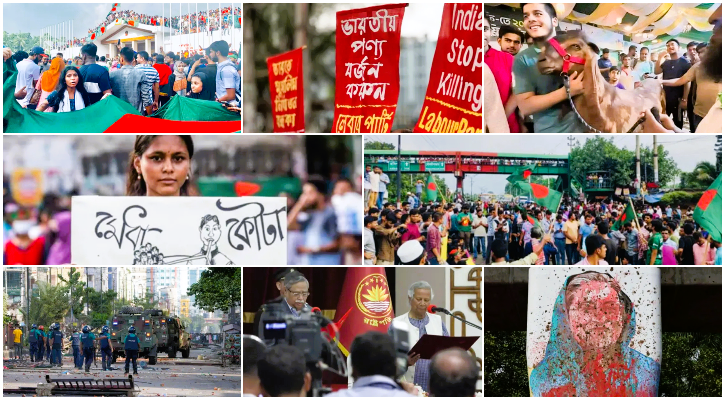
2024 witnessed various incidents, elections, political unrest, economic crisis, movement-protest, collapse of the government, forming a new government, Bangladesh has witnessed one after another.
Faced with new political reality and equations.
Another controversial vote
2024 started 07 January 2019 was held in the midst of the political tension and uncertainty. National Assembly elections.
The twelfth is controversial due to the absence of opposition political parties and the rate of voter turnout. National Parliament Elections The controversial election in the history of Bangladesh Sheikh Hasina became the prime minister for the fifth time in the history of Bangladesh.
Anti-India campaign and politics
After the elections, anti-India politics started to take root in Bangladesh. The speed of the Indian product is the out-of-commission campaign, the indi- t indita and indita out campaign. The support of the Indian League is to be held for the power of the Awami League despite the controversial elections.
Corruption, Goats and Others
Bangladesh has always been at the bottom in Transparency International's ‘corruption's concept index’ At the beginning of 2024, the organization reported that the country's position as corrupt in the previous year's survey was 10th.
The news of the corruption of the former army chief, the former police chief in the 24th, has been widely discussed and some more corruption news has also made public news.
Dhaka Metropolitan Police's former Commissioner Asaduzzaman Mita has also published reports on ‘abundant wealth’.
The son of a revenue officer named Matiur Rahman gave birth to a heated discussion to buy a goat of ‘15 lakh taka’ from an agro farm on the occasion of Eid-ul-Azha i.e. Eid al-Adha.
Based on this news, the anti-corruption commission started an investigation against Matiur Rahman.
Reinstatement of freedom fighter quota
In the face of the student movement, the High Court declared the notification issued in 2018 by canceling the quota system in two categories of government recruitment, which has resulted in the reinstatement of the freedom fighter quota system in the first and second class government jobs.
The angry reaction came on behalf of the students and they talked about the movement demanding logical reforms.
Eventful July: Month of the Movement
In the same context of the quota reform movement, the university teachers have come out to cut their names from the universal pension system. The public universities are heated in separate movements of teachers and students and at the same time stagnated in terms of education programs.
The leaders and activists of the anti-discrimination student movement continued to run the program called ‘Bangla Blockade’, in the meantime, the Appellate Division gave the status quo of the High Court on the 10th, but the next hearing was set for four weeks.
Sheikh Hasina returned from her visit to China that day, and she said at a press conference on July 14, ‘The government has nothing to do if it does not come to a solution from the court.’
He asked there, ‘Why so much anger on the freedom fighters? Grandsons of freedom fighters will not get jobs, then will Razakar's grandchildren get?’
His statement saw a strong reaction from that night in various universities of the country including Dhaka University and the campus was seen chanting this slat - ‘Tumi who, am who am I? Razakar, Razakar.’
Violence য় Bloody University
On July 15, Dhaka University as well as universities outside the capital The attack on the agitators was reported to have been reported by the two sides, and many were injured in the conflict and the conflict, and the first death of the death occurred on July 16.
Violence with Chhatra League and police in the movement has killed six people across the country. Among them, the video of Abu Said, a student of Begum Raketa University in Rangpur, was found and killed in front of the police.
The student of Rangpur became a symbol of protest in the country. On this day, the Chhatra League has been displaced from all the campuses including the Dhaka University which is an unprecedented event for the organization of the ruling party.
The violence continued on July 17. All forms of education in the country The institution will be closed indefinitely.
Complete Shutdown
Across the country, protesting killings and attacks The anti-discrimination student agitation announced the complete shutdown program on July 18. On this day, the protestors' clauses with the police of the capital were closed due to the clashes and clashes of the Dhaka-Chittagong Mahasak.
Badda, Uttara, Jatrabai and Mirpur areas have become battlefields. News of conflict-violence between police, Chhatra League and Jubo League with protesters from districts outside Dhaka has been reported by the state media - Bangladesh Television or BTV building.
On this day, a large number of private universities gathered in Dhaka, and there were incidents of police chaos and retaliatory incidents. As of Thursday night, the BBC Bangla was able to confirm the death of 25 people.
Mobile internet connection was not available in different parts of the country. At one stage mobile internet was completely closed. At night broadband internet also shut down.
The government agreed to hold talks with the agitators in the situation, said Law Minister Anisul Haque, who rejected the proposal of the students' platform, which was anti-discrimination student movement.
On Friday, July 19, massive protests and clashes continued in the country, including Dhaka, and the situation was halting in the towns.
all over the country The information about at least 56 people killed in the clash is known for sure. The number of injured was also several times higher than the situation, the situation was out of control and the curfew was issued from 12 midnight.
Last 10 days of July
Amid the curfew, on Saturday, July 20, there were clashes between the police and law enforcement agencies in Dhaka, Savar, Gazipur, Mymensingh, and many protesters were killed in Dhaka and Narayanganj.
On July 22, the appeals division hearing The High Court's verdict on the reinstatement of the quota is canceled by 93 percent of the merit, the freedom fighter is 5 percent, the minority is 1 percent, the disabled and the third gender are cut off. The court ordered the determination of 1 percent.
On Monday, July 22, the complete shutdown was suspended for 48 hours, Nahid Islam, one of the co-ordination of the quota movement, continued to remain in the curfew, but the anxiety and tension continued.
As a result of the movement, the number of arrests and cases in the country, including Dhaka, has increased.
On July 26, the three concurrents of the anti-discrimination student movement, Asif Mahmud, Nahid Islam and Abu Bakr Majumdar were picked up by the Police Department (DB). In the next few days, some more people will be taken to the DB office.
Nahid Islam, a co-author of the quota reform movement, gave a video message to withdraw the program in the custody of the police station, but other co-authors complained that the statement was being given a hostage torture.
Bangladesh in August
August 2. Teachers and Civil Society ‘Travel Yatra’ A few thousand people joined the programme from the National Press Club to the TSC area of Dhaka University and held a rally at the Central Shaheed Minar.
On August 3, the anti-discrimination student movement called for a large gathering at the central Shaheed Minar in Dhaka and the Newmarket area of Chittagong, where thousands of people participated in the procession and rallies in different parts of the country.
The government has not been allowed to have one minute of power, said the government, for the government's resignation from the rally in Dhaka.
The government has announced a three-day general holiday from 4th to deal with the situation arising from the non-cooperation program for the protestors to hold the ‘all-un-cooperation’ program from August 4.
On this day all over the country Violence reported that at least 83 people including the police were reported to have killed many people.
First August 06 was announced, but later one day, the anti-discrimination student movement of Long March to Dhaka to demand the fall of the government on August 5.
The fall of Sheikh Hasina
On August 04 and 05, the Aoami League had announced a gathering and guarding on the terrace on the hartard of Dhaka to counter the anti-government protests, but they could not stand up to the opposition.
In the morning, the entrances of Dhaka were under the control of the security forces, but after the afternoon, the agitators started entering the city in some areas including Uttara.
By noon, the streets of Dhaka literally went to the agitators' urges. Millions of people are seen marching in the main places of Dhaka.
At one point, news came that Sheikh Hasina had left Bangladesh after she resigned from the post of Prime Minister, accompanied by her Ben Sheikh Rehana.
three days without government
There was virtually no government in Bangladesh for three days from the 5th. As a result, the country's law and order situation was severely deteriorated. The party offices and activists of various districts including Dhaka and many activists were vandalized, arson and looting.
There were also incidents like theft, robbery and robbery, and there were reports of theft, robbery and robbery.
forming an interim government
The interim government was formed on August 8 by making Nobel Jay Professor Muhammad Yunus the chief adviser and Muhammad Yunus received the support and congratulations of various countries immediately after the formation of the government.
On the other hand, the resignation of top officials of government, semi-government and even private institutions is seen.
In this case, some willingly take the position. Again, in many institutions, the officials were forced to resign in the face of various pressures including protests, insults and disgrace.
There are changes in various positions from the Secretary to the Deputy Commissioner, Superintendent of Police, UNO, and there will be massive changes in the administration.
Many of the opposition politicians who have been in jail for a long time have already been released.
Minority Issu
After the fall of the government, the protests against the oppression of minorities and the question of rights were raised by the organization in Chittagong with the eight-point demand.
The new platform called Sanatani Jagran Manch was arrested and the situation became heated in the same time after the arrest of Chinmath Krishna Das, the spokesperson of its spokesperson.
A lawyer named Saiful Islam was killed in a clash with his followers with the police.
The information about minority oppression in Bangladesh has already been widely disseminated in the media and social media, but the BBC's investigation has shown that the news and pictures are widely seen.
Bangladesh -Indian relationship
Since the fall of the Sheikh Hasina government, the tension between Bangladesh and India has become increasingly evident, but the economic and commercial relations are fairly active, but the visa process has been stopped.
Ashrata Deota to Sheikh Hasina, Bhuta Khabar of minority torture in Bangladesh, the relationship between the two countries will deteriorate due to the flood situation at the end of August.
The incident is more intensified by the arrest of Chinmash Krishna Das, the spokesperson of the Combined Sanatani Jagran Jot, and the violence against him and the murder of lawyer Saiful Islam Alif.
A few religious organizations including the ruling party BJP started holding protest programs towards the Deputy High Commission of Kolkata demanding the release of Chinma Das.
Its continuation of this was the national flag of Bangladesh was placed in front of the Kolkata Deputy High Commission on November 28. On December 2, suddenly there was an attack, vandalism and flag insulting at the Assistant High Commission of Agartala Bangladesh.
The incident was reported by Bangladesh, ‘Angry Practice’. India expressed regret, which was later arrested and three policemen were dismissed.
At the end of December, Bangladesh sent a diplomatic letter or ‘note verbal’ to bring Sheikh Hasina back from India.
Reform and Justice
After the political change in Bangladesh, the demand for state reform became increasingly strong, and the total number of commissions formed to reform the sector in 15.
The interim government formed a white paper production committee to find out what state the country's economy has left behind the ousted Awami League government.
It is said in the white paper that 234 billion US dollars have been illegally smuggled from Bangladesh through corruption in 28 subsidies in the last 15 years.
In the meantime, the Fifteenth Amendment of the Constitution was partially repealed by the court. As a result, the legal barrier to the introduction of a caretaker government system was removed.
The government reorganized the International Criminal Tribunal to prosecute the killings and tortures that took place on the quota movement.
In the changing political situation, there are countless allegations and news of corruption against Sheikh Hasina's family and her minister-MPs. The anti-corruption commission started an investigation.
Fragile banking sector: liquidity crisis
The banking sector of Bangladesh has been under discussion for a long time. The practice is a new logistics addition at the beginning of the year, a research report from the Central Bank.
Before this, Bangladesh Bank had been suggesting to integrate all weak or bad banks with strong or good banks for the purpose of reforming the banking sector, although the integration of political turns did not come into effect.
The liquidity crisis in the private sector's nitty banks has been evident since the middle of the year, they could not provide the money to the customers. In November, the new Governor Ahsan H Mansoor announced the release of the sixth weak bank in November.