
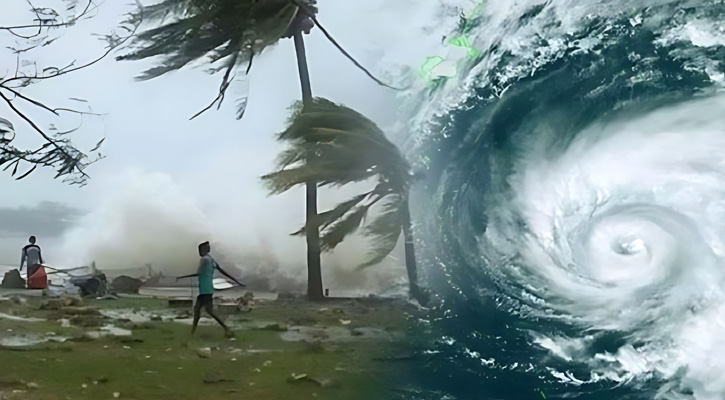
The Department of Meteorology is known to be as strong as Sidor, which hit the southern coast of the country in 2007, which is very strong in the Bay of Bengal.
Today Saturday (May 13) in a press conference, the deputy director of the department. Asadur Rahman said this.
He said, "The impact of Mokha in the region of St. Martin, Teknaf and Ukhita is the most likely to be the highest when it is on the shore, the wind speed will be more than 160 kmph.
The rains that will affect the rains are likely to cause landslides if there is a continuous rain for more than eight hours, there may be heavy rains in Barisal and Chittagong divisions.
Dr. weatherman. Md. Abul Kalam Mallik said that each cyclone has distinct characteristics and compared to Sidor, as long as it is in the Bay of Bengal, its energy will continue to be in the fold. It is going to get to the point, the wind is moving, the wind is going to be the same as the wind blows.
In the briefing, the joint director highlighted the special notification number 14 and said that the very strong cyclone ‘Mokha’ stationed in the east-central Bay of Bengal and adjacent areas is moving towards the north-northeast in the same area. It is 815 km south-southwest from Chittagong seaport, 745 km south-southwest from Cox's Bazar seaport, 745 km south-southwest of Mongla seaport and 745 km from Mongla seaport.
It may move further north-northeast and cross the coast of Cox's Bazar and northern Myanmar between 6 am and 6 pm on May 14. From Saturday (May 13) night, the influence of very heavy cyclone Mokha may start in the coastal areas of Chittagong and Barisal divisions.
Meanwhile, Cox's Bazar and Chittagong seaports have been asked to show the disaster signal number 8 (re) 8 (re) 8 (eight) disaster signal number 8 (re) and the local warning signal number 4 (4) will be shown local warning signal number 4 (re) number 4 (4) will be shown.
On the other hand, the high cyclone can be flooded with high cyclones and low-lying cyclones in the coastal districts of Cox's Bazar and the lower part of the cyclone.
How strong is the mouth?
The data-data analysis of various equivalences shows that there are two seasons of cyclone in the Bay of Bengal, one before the monsoon, i.e. from the end of April to May. Another after the monsoon, i.e. in October-November.
Weather expert Dr. Samarendra Karmakar says, the temperature of C surface is very high in these two Sam's C surfaces. The arrangement of the balsam is also favorable. When the sun goes from one hemisphere to another, this sum is over the south, the Bay of Bengal is very hot.
Weather experts said that in March and April of this year, there is no low pressure, low pressure or cyclone in the middle and north Bay of Bengal, as a result of which the first cyclone is going to be the first cyclone this year. Therefore, the entire season has warmed the water of the Bay of Bengal and has heated up the water of the Bay of Bengal.
According to experts, the water temperature map of the Bay of Bengal is going to be formed in the most high temperature water in the last few years. The more the cyclone moves in the north, the more it will come in contact with the hot water.
The temperature of the sea surface is above 27 degrees and the energy stored in the sea will be sufficiently voluminous, which will be the result of the cyclone, which can be seen as a very severe cyclone in the coastal region.
As was the 2007 Sidor
Cyclone Sidor, which hit the southern coast of the country on November 15, 2007, took the lives of nearly 6,000 people, although according to the Red Crescent, the number of deaths was about 10,000.
The wind speed was 260 to 305 km in the storm that formed near the Andaman Nicobar Islands in the northern Indian Ocean.
Sidor ran riot in Khulna and Barisal areas. Everything floated by the 15 to 20 feet high tide rising from the sea goes 2 million people in 32 districts were affected by the storm and about six lakh tons of paddy was destroyed in the coastal areas. Along with the animals of the Sundarbans, many cattle die.