None of the country's mainstream and major political parties are seeking to participate in a single-minded polling No. The already allied parties are trying to gain power instead of getting to vote in the current power.
The ruling 14 parties and their rival BNP are thinking of alliance or compromise with the new party.
The main opposition party in the parliament, Hussain Muhammad Ershad, also has a separate alliance, the size of his alliance, the size of the party, which is 58 in all the mills, at least the alliance has said so.
The last alliance was formed by eight left parties, which are also part of the party known as pro-Russian and pro-Chinese.
The Aomi League has also spoken to the alliance to form the alliance with former BNP leader Nazmul Huda, which has not come alone, and has come to the other party.
BNP is also interested in the national unity outside its Dhows alliance. The alternative movement formed by BNP, former Aomi League leader Mahmudur Rahman Manna's Nagrik Oikya is being discussed with various parties.
Veteran lawyer Kamal Hossain is also coming again in the ‘Jati Oikya Prakrita’.
In the meantime, the United Front, which formed last December, has again announced that it will be a third power, and they are now in close proximity to the BNP.
Apart from them, there has been news of the media's efforts to form a new alliance in the initiative of the political small and paddled parties of the Qaumi Madrasah.

The formation of an election-centered alliance in Bangladesh in parliamentary politics is also something new. The rivalry of BNP and Aomi League in the 1991 national election is also called the alliance leader of the Awami League.
But then in 1996, the main political parties were voting for their power.
After that in 2001, Aomi League single-handedly joined BNP and gave the power of the alliance.
Then before 2006, the Aoami League also formed an alliance and the power of the alliance in the 2008 national election brought the four-party alliance to the power of the state.
After that, the BNP alliance has 20 parties to fight the size of the BNP alliance, and the number of parties in the division is more than 20.
However, the current political reality is to create a new alliance or try to grow the alliance again, whether it will bring benefits for the party or not, this is the question.
Because the new alliances are being formed or those who are negotiating with the party to participate in the alliance have no organizational strength, no popularity. One party leader or two leaders of one party - this is how to identify each other.
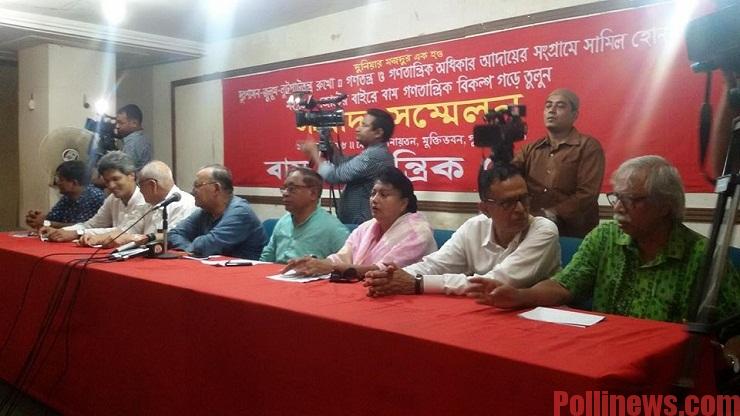
Mujahidul Islam Selim, president of CPB who formed a new alliance, was the question of what is the benefit of forming an alliance.
The answer comes, ‘This alliance will not bring any fundamental change in the formation of this alliance in the politics of Bangladesh. Our movement is against the capitalist system. We want to assemble the power in the politics of this country by ignoring the principles of power in the politics of this country. They want to do politics in politics. We want to bring the nation out of the culture of unscrupulous politics. It is possible to rescue the nation from these two parties.’
‘We want to implement the concept of the four principles of the liberation war. We will do a lot of things in the context of the struggle. We will hold elections and again in the context of the struggle for the struggle.’

However, it is debatable how much Salim can do in an alliance. The power of the left is to lose the strength of the left, they break and the leaders have moved to all the party parties. The votes that the CPB-Bas candidates got in the Khulna and Gazipur City Corporation elections on May 15 in Khulna and June 26 are quite unremarkable.
When asked about the issue, Professor Govinda Chakraborty of the Department of Political Science of Dhaka University said, ‘This poison was something new, this alliance was a culture of forming an alliance for many years in the politics of Bangladesh. Even before 71, it was the United Front that an election alliance was formed in this country.’
‘It is not possible to say what will affect the next movement in the upcoming elections, it is reported that the alliance of the twenty parties is trying to break up 9 parties and work with the Awami League.’
‘It is not possible to say what effect these parties can have. The left has formed a Jagat alliance again. It is difficult to say what movement they will take on 1% votes.’
When asked, the former vice-chancellor of Dhaka University, Emajuddin Ahmed, said, ‘If these alliances are formed in front of the election, then the election will be transparent, there will be a lesser one, thereby the power of the ruling party will be a little less. But everything depends on the situation.’

Political analyst Mizanur Rahman Shelley said, ‘The politics of the alliance is something new in Bangladesh, the alliance between the political parties has been going on for a long time in the election year. The main parties think that more forces form an alliance with their strength. Although the votes of these parties do not have much influence, but the number of them is in terms of numbers.’
‘These small parties are relying on the main power, and don't think they are important. How the election will pass is the main poison now.
Dhaka Times ’